A hundred thousand billion poems is a collection of experimental poetry written by Raymond Queneau, designed by Robert Massin, and published by Gallimard in 1961. This note is a reworked excerpt from the research thesis “The hand behind on-screen type” published in 2022.
According to Robert Massin's design, A hundred thousand billion poems is composed of a single sonnet where each of the 14 lines, printed on a horizontal strip, has 10 different versions. This device allows the reader, by flipping the strips, to compose 1014 different sonnets.
The book belongs to a rare genre that promises the reader the possibility of interfering with otherwise rigid book designs to become active, to become an author.
Does it fully deliver on its promises?
Guillaume Pavius
Note
Art & design
Monday, April 13, 2026
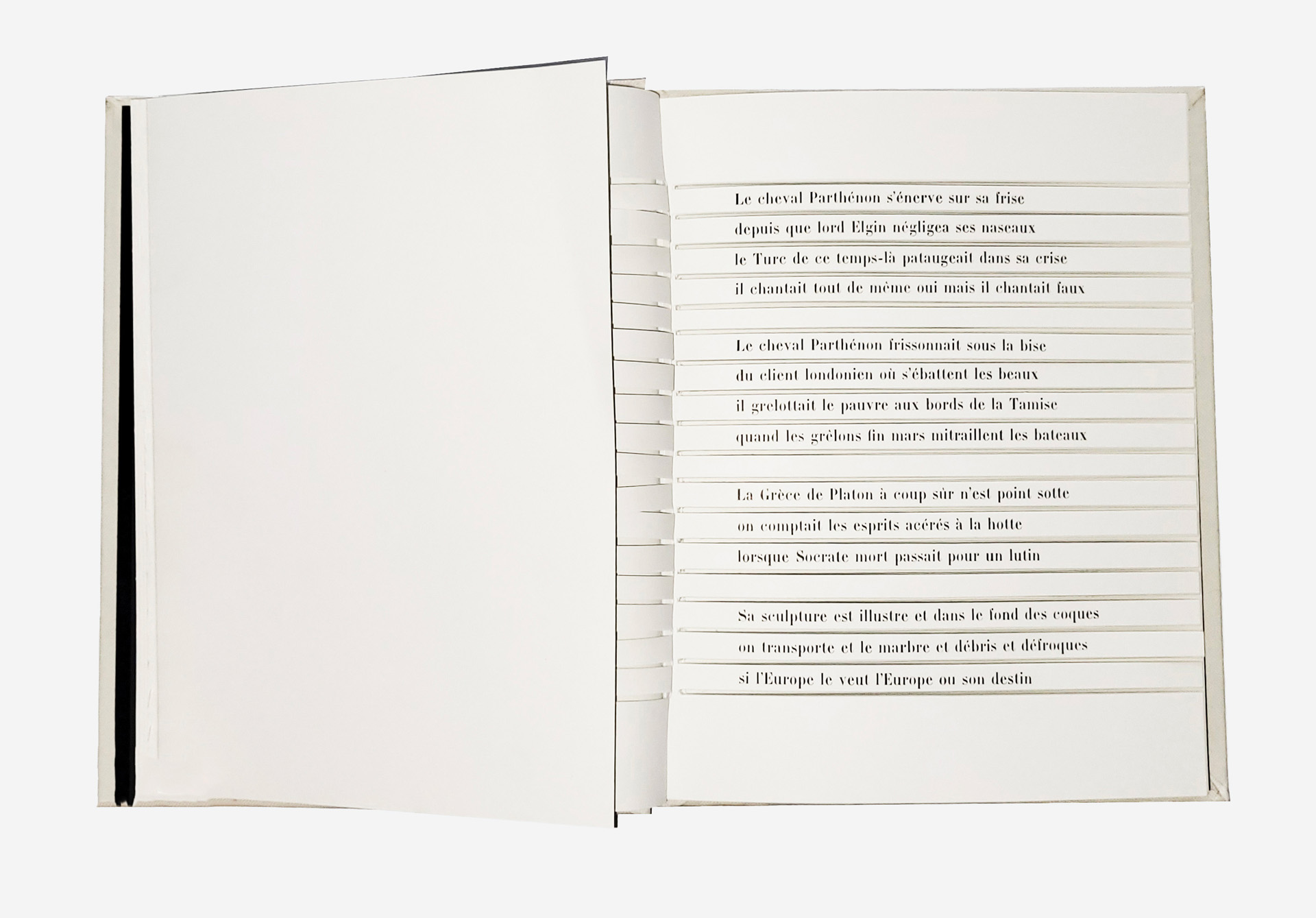
The 1961 edition
The 1961 edition combinatorics
Instructions for use
“Counting 45s to read a sonnet and 15s to change the flaps, 8 hours a day, 200 days a year, one has over a million centuries of reading; and reading all day long, 365 days a year, for 190,258,751 years plus a few bells and whistles (without taking into account leap years and other details).” 1 Raymond Queneau sets the tone: the work does not offer an unlimited number of poems, but an inexhaustible one. One will not read them all—but how many will one actually read?
The book was inspired by “changeable heads” a type of children's book where the image of a character is sliced into independent strips, often mounted on Wire-O bindings.
The book and its making
In the case of A hundred thousand billion poems , the manufacturing processes of “noble” bookmaking were chosen to handle these interchangeable lines. It features a substantial joint behind which the pages (cut into strips) are bound, and a flap to hold them in place.
In practice, the first obstacle to handling the collection and activating the combinatorics lies here: the strips are difficult to maneuver, and the book does not stay open on its own.
From intention to reception
In the Queneau archives
Raymond Queneau employs an “economy of means” in the typographic treatment of his verses. Of the 140 lines printed on the strips, only five question marks remain as the sole punctuation. Strict adherence to the sonnet structure and a minimalist layout ensure that, regardless of the combination chosen by the reader, the structure remains intact. However, studying Queneau's archives reveals that the author first wrote ten “progenitor-sonnets” 2 (two of which even had provisional titles) with highly identifiable themes, which he only sliced up afterward. A combinatorial logic did not exactly preside over the work's conception from start to finish.
The Actual Reading Experience
Readers confronted with the book quickly realize that “the combinations one can forge, by relying on chance, [are] not all of equal value.” 3 However, with this edition (a technical tour de force where all the strips flutter about) combining lines can only be done by chance. Consequently, many combinations far removed from the original “progenitor-sonnets” fail to make sense.
Other editions
Paper editions, translations, and other mediums
A hundred thousand billion poems has seen several other editions. In 1989, Gallimard published the ten progenitor poems in Queneau's Complete Works without the cuts that allow for combinatorics. An English translation was published in 1983, a German one in 1984, and a Chinese one in 2020. There is also a “machine” designed by Robert Kayser in 1994 where the lines are written on scrolls, as well as a chocolate bar adaptation by Stéphane Bureaux in 2017.
Digitizations
The digital adaptation of what Queneau called his “poem-composing machine” quickly became an obvious step. Adaptations by Tibor Papp (1989) and Magnus Bodin (1997) allow a computer screen to display poems drawn at random from the hundred thousand billion with a simple mouse click. However, this setup, which leaves much to chance and reduces the reader’s field of action, was not entirely satisfactory; reception by the OuLiPo group remained mixed 4.
What experimental typography can bring to experimental literature
Based on this analysis of Queneau’s work underlying the physical limitations of the 1961 edition and the unsatisfying nature of previous digital adaptations, a “revisitation” of the Queneau process could be proposed. This revisit moves away from the fixed typeface of the original edition (Didot) to include typography itself in the combinatorial process. The “cut” enters the very flesh of the type; from the text emerges the image of the text, which in turn reveals fragments of writing at the whim of the reader-author's back-and-forth movements.
Notes :
1 Raymond Queneau, “Mode d’emploi”, Cent mille milliards de poèmes, Gallimard, 1961.
2 Raymond Queneau, “Notes préparatoires ” folder, Dijon University Library, cote D114.
3 François le Lionnais, “À propos de la littérature expérimentale” dans Raymond Queneau, Cent mille milliards de poèmes, Gallimard, 1961.
4 Per Jonathan Baillehache, “The digital reception of a hundred thousand billion poems”, Sens public, Université de Montréal, 2021, https://sens-public.org/articles/1498/.